[et_pb_section fb_built=”1″ _builder_version=”4.27.0″ _module_preset=”default” custom_padding=”0px||0px|||” global_colors_info=”{}”][et_pb_row column_structure=”1_2,1_2″ _builder_version=”4.27.0″ _module_preset=”default” global_colors_info=”{}”][et_pb_column type=”1_2″ _builder_version=”4.27.0″ _module_preset=”default” global_colors_info=”{}”][et_pb_image src=”https://historicalblackprecinct.org/bpm/wp-content/uploads/2019/02/Dz8gxxNX0AMPBSn-370×349.jpeg” title_text=”Dz8gxxNX0AMPBSn” _builder_version=”4.27.0″ _module_preset=”default” global_colors_info=”{}”][/et_pb_image][/et_pb_column][et_pb_column type=”1_2″ _builder_version=”4.27.0″ _module_preset=”default” global_colors_info=”{}”][et_pb_text _builder_version=”4.27.0″ _module_preset=”default” text_font=”–et_global_heading_font||||||||” hover_enabled=”0″ global_colors_info=”{}” sticky_enabled=”0″]
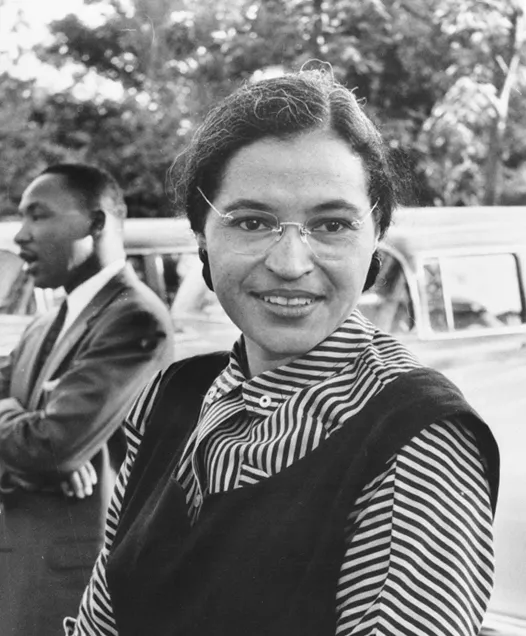
Rosa Louise McCauley Parks (February 4, 1913 – October 24, 2005)
[/et_pb_text][et_pb_text _builder_version=”4.27.0″ _module_preset=”default” global_colors_info=”{}”]
Rosa Parks was an American activist in the civil rights movement best known for her pivotal role in the Montgomery Bus Boycott. The United States Congress has called her “the first lady of civil rights” and “the mother of the freedom movement”.
[/et_pb_text][/et_pb_column][/et_pb_row][et_pb_row _builder_version=”4.27.0″ _module_preset=”default” global_colors_info=”{}”][et_pb_column type=”4_4″ _builder_version=”4.27.0″ _module_preset=”default” global_colors_info=”{}”][et_pb_text _builder_version=”4.27.0″ _module_preset=”default” global_colors_info=”{}”]
On December 1, 1955, in Montgomery, Alabama, Parks rejected bus driver James F. Blake’s order to relinquish her seat in the “colored section” to a white passenger, after the whites-only section was filled. Parks was not the first person to resist bus segregation, but the National Association for the Advancement of Colored People (NAACP) believed that she was the best candidate for seeing through a court challenge after her arrest for civil disobedience in violating Alabama segregation laws. Parks’ prominence in the community and her willingness to become a controversial figure inspired the Black community to boycott the Montgomery buses for over a year, the first major direct action campaign of the post-war civil rights movement. This year-long boycott resulted in the desegregation of buses in Montgomery, Alabama on December 20, 1956. Rosa Parks remained a civil rights activist until her passing. When she passed away in 2005, she became the first female American who was not an elected official to lie in honor in the rotunda of the U.S. Capitol.
Image: Rosa Parks in a beauty salon in Miami, 1986. Courtesy of the Library of Congress
[/et_pb_text][/et_pb_column][/et_pb_row][/et_pb_section]
More at this venue
 Tue, Jan 19
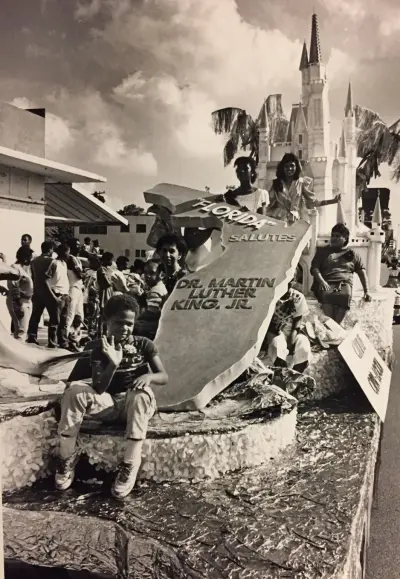
Dr. Martin Luther King Jr. Day
Kids & family · Historic Black Police Precinct Courthouse and Museum
 Thu, Feb 4
Rosa Park’s Birthday
Kids & family · Historic Black Police Precinct Courthouse and Museum
Tue, Jan 18
Dr. Martin Luther King Jr. Day
Kids & family · Historic Black Police Precinct Courthouse and Museum